What I Found Wandering Through Iguazu’s Mist
You know that feeling when nature just slaps you in the face with beauty? That’s Iguazu Falls. Wandering its trails, I didn’t just see water—I felt it. The roar, the spray, the rainbows dancing in the mist. It’s not just a view; it’s an experience that grabs you. This isn’t about ticking boxes. It’s about getting lost, feeling small, and finding awe in every step. In a world that moves too fast, places like Iguazu remind us to pause, to breathe, and to witness something far greater than ourselves. It’s not just a destination—it’s a transformation disguised as a walk in the woods.
Arrival and First Impressions
Stepping into Iguazu National Park from the Brazilian side, the first thing that greets you is the air—thick, warm, and rich with the scent of wet earth and greenery. It’s the breath of the Atlantic rainforest, one of the last strongholds of this once-vast ecosystem. Almost immediately, a deep, rhythmic rumbling fills the atmosphere. At first, it sounds like distant thunder, but there’s no storm in sight. The source becomes clear as you follow the winding path through towering trees draped in vines: it’s the falls. Not one, but hundreds of them, cascading in unison across a two-kilometer front.
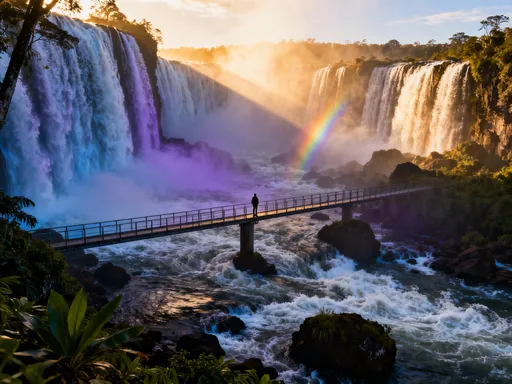
The first panoramic view from the main observation platform is nothing short of staggering. Photos, videos, and documentaries fail to capture the sheer scale. You stand at the edge of a natural wonder that feels more like a force of nature than a scenic attraction. The water tumbles over limestone cliffs, splitting into 275 individual falls, each with its own character and rhythm. The mist rises in great plumes, catching sunlight and scattering it into fleeting rainbows. Visitors instinctively fall silent, not out of reverence, but because words simply don’t fit here. This is not a place for commentary—it’s one for presence.
From this vantage point, the power of Iguazu is undeniable. The falls straddle the border between Brazil and Argentina, fed by the Iguazu River, which swells during the rainy season and maintains impressive flow even in drier months. The Brazilian side, though slightly less extensive in trail coverage than its Argentine counterpart, offers some of the most breathtaking wide-angle views. It’s here that you begin to understand that Iguazu is not a single waterfall, but a vast, interconnected system—a living network of water, rock, and forest that has shaped the landscape for millions of years.
The Art of Wandering: Why Slow Exploration Wins
Most visitors arrive with a mission: reach the Devil’s Throat, take the photo, and move on. But the true soul of Iguazu reveals itself not in milestones, but in moments. Wandering—purposeful, unhurried exploration—is the key to unlocking its deeper magic. When you allow yourself to meander, you begin to notice the details that fast-paced tourism often misses. A cluster of bromeliads clinging to a tree trunk, their cups filled with rainwater. A frog no bigger than a thumbnail perched on a damp stone. The way sunlight filters through the canopy, striking the mist at just the right angle to ignite a spectrum in midair.
There’s a rhythm to the falls, and when you slow down, you start to sync with it. The constant roar becomes a kind of meditation, a white noise that clears the mind. The mist, carried on the breeze, cools your skin like nature’s own air conditioning. You find quiet corners where the crowds haven’t reached, where the only sounds are the rush of water and the occasional call of a toucan. These are the moments that stay with you—not the checklist items, but the unscripted encounters with wonder.
Wandering also allows for serendipity. You might turn a corner and find a secluded bench overlooking a lesser-known cascade, or catch a glimpse of a coati darting through the underbrush. You might pause to watch how the water swirls into a deep green pool before surging forward again, carving its path over centuries. This kind of travel isn’t about efficiency; it’s about immersion. It’s about trading speed for depth, and in doing so, discovering that the journey itself is the destination.
Viewing the Unseen: Unique Angles on the Brazilian Side
While many travelers focus on the Argentine side, which offers more extensive trails and closer access to certain falls, the Brazilian side delivers something equally valuable: perspective. The elevated walkways here extend over the Iguazu River, allowing you to stand above the churning rapids just before they plummet into the gorge. It’s a vantage point few anticipate, and even fewer forget. From these platforms, you can watch the river gather its strength, flowing faster and more fiercely as it approaches the edge, as if aware of the drop ahead.
One of the most striking views is of the San Martín Falls, a powerful cascade that crashes into a cauldron of white foam below. Unlike the narrow, intimate paths on the Argentine side, the Brazilian trails are designed for sweeping panoramas. The observation decks are spaced to maximize visibility, with minimal railings to obstruct the view. This deliberate openness creates a sense of vulnerability—and connection. You’re not separated from the falls by glass or metal; you’re part of the scene, exposed to the wind, the sound, the spray.
Another advantage of the Brazilian side is the relative lack of crowds, even during peak season. While the Devil’s Throat area on the Argentine side can feel congested, especially in midday hours, the Brazilian trails offer solitude. You can find a quiet spot to sit, breathe, and simply absorb the scale of what’s in front of you. The park management has done an excellent job balancing accessibility with preservation, ensuring that infrastructure supports visitors without overwhelming the natural environment. It’s a model of sustainable tourism—thoughtful, respectful, and deeply effective.
The Devil’s Throat Experience: Power Up Close
No visit to Iguazu is complete without standing at the edge of the Devil’s Throat—Garganta del Diablo—a U-shaped chasm where the majority of the river funnels into a single, thunderous drop. Reaching it requires a short train ride from the main entrance, followed by a wooden walkway that extends nearly 1,100 meters into the heart of the falls. As you walk, the sound grows louder, more insistent, vibrating through the boards beneath your feet and into your chest. The air thickens with mist, and the temperature drops noticeably.
Then, suddenly, you’re there. The walkway ends at a semicircular platform suspended over the abyss. Below, 14 major falls converge, sending 1.3 million liters of water per second plunging 82 meters into the churning pool below. The force is overwhelming. The noise is not just heard—it’s felt, a deep, primal rumble that resonates in your bones. The mist rises in a perpetual cloud, drenching everything in its path. Rainbows flicker in and out of existence, born and dissolved in seconds, as if the air itself is too alive to hold still.
This is not a place for the faint of heart. The wind is unpredictable, the spray relentless. Even with a poncho, you will get wet—probably soaked. But that’s part of the experience. There’s no barrier between you and the raw power of nature. You’re not observing from a distance; you’re standing in the middle of it. And in that moment, you understand what awe truly means. It’s not admiration. It’s humility. It’s the recognition that some forces are beyond human control, beyond human scale. The Devil’s Throat doesn’t just impress—it transforms.
Beyond the Falls: The Living Ecosystem Around You
Iguazu Falls is often celebrated for its water, but the true marvel lies in the life that surrounds it. The park is part of the Atlantic Rainforest, a UNESCO World Heritage site and one of the most biodiverse regions on the planet. This is not a backdrop; it’s a co-star. Over 2,000 species of plants, 400 species of birds, and hundreds of mammals, reptiles, and amphibians call this place home. Every step along the trail is an invitation to discovery.
Coatis, with their ringed tails and curious eyes, roam freely, often approaching visitors in hopes of a snack—though feeding them is strictly prohibited. Brightly colored toucans, their beaks like painted curves, perch in the palms, their calls echoing through the trees. Butterflies flit between flowers, and tiny frogs cling to damp leaves, their skin glistening in the filtered light. The forest floor is a tapestry of roots, moss, and fallen leaves, all contributing to a cycle of life that has thrived here for millennia.
The vegetation itself is a wonder. Giant ferns unfurl in the shade, while orchids and bromeliads bloom in the canopy, drawing nectar from the constant moisture in the air. Trees with trunks wider than a person can embrace rise toward the sky, their branches hosting entire ecosystems of epiphytes and insects. This biodiversity isn’t just a bonus—it’s essential. The health of the falls depends on the health of the forest. The trees regulate water flow, prevent erosion, and maintain the microclimate that keeps the mist rising and the rainbows forming. To walk through Iguazu is to witness an intricate, interdependent system in perfect balance.
Practical Wandering: What to Know Before You Go
Planning a visit to Iguazu requires more than just booking a flight. The nearest major gateway is Foz do Iguaçu, a city in western Paraná state, Brazil, with international connections from São Paulo, Rio de Janeiro, and Buenos Aires. While it’s possible to visit both the Brazilian and Argentine sides in a single trip, each requires a separate entry and offers a distinct experience. The Brazilian side is ideal for panoramic views and a more relaxed pace, while the Argentine side provides more extensive trails and closer access to several falls, including the Devil’s Throat.
Entry to the park must be reserved in advance, especially during the dry season (April to September), when weather is most favorable and crowds are largest. Tickets can be purchased online through the official park website, and it’s advisable to book at least several weeks ahead. The park opens at 8:00 AM and closes at 5:00 PM, with last entry at 3:00 PM. Arriving early ensures fewer crowds and better lighting for photography.
What you wear matters. Quick-dry clothing is essential—cotton will stay wet and uncomfortable. Sturdy trail shoes with good grip are non-negotiable; the paths can be slippery, especially near the falls. A lightweight, waterproof poncho is far more practical than an umbrella, which is nearly useless in the wind and spray. Backpacks are allowed, but large bags may be restricted on certain trails. Bring plenty of water—there are refill stations, but options are limited. Snacks and meals are available at the park’s café, but choices are basic and prices are high, so consider bringing your own food.
Weather plays a significant role in your experience. Summer months (December to February) bring high heat and humidity, along with the risk of sudden downpours. While the falls are most powerful during this time, the conditions can be taxing. The dry season offers more predictable weather and clearer skies, though water volume is slightly reduced. Regardless of season, mornings and late afternoons provide the best light, fewer visitors, and cooler temperatures. And one final tip: silence your phone. Not to disconnect, but to truly listen—to the roar of the water, the rustle of leaves, the call of the wild.
Why This Kind of Travel Stays With You
Wandering through Iguazu changes you. It’s not the kind of change that happens all at once, but one that settles in quietly, like mist on skin. In the days and weeks that follow, you’ll find yourself recalling small moments: the way the light caught the spray at sunset, the sound of the falls at dawn, the sight of a butterfly riding the breeze. These memories aren’t just images—they’re sensations. They live in your body as much as in your mind.
What makes Iguazu different from other destinations is its insistence on presence. You can’t scroll through your phone while standing at the edge of the Devil’s Throat. You can’t multitask when the mist is soaking your clothes and the roar is filling your ears. For a few hours, you are fully engaged—awake, aware, alive. This is participatory travel at its purest. You’re not just observing nature; you’re interacting with it, feeling its pulse, breathing its air.
And in that interaction, something shifts. You begin to see nature not as a resource or a backdrop, but as a presence—vast, ancient, and deeply intelligent. You remember that you are part of this world, not apart from it. The falls don’t care about your schedule, your stress, your to-do list. They’ve been flowing long before you arrived and will continue long after you’re gone. In their constancy, there is comfort. In their power, there is perspective.
That’s the gift of Iguazu—not just the beauty, but the reminder. A reminder that wonder is still possible. That awe is still available. That slowing down, getting lost, and simply being can be the most transformative journey of all. Long after the photos fade and the souvenirs gather dust, this feeling remains: the echo of water, the taste of mist, the quiet knowing that you stood before something magnificent—and for a moment, you were part of it.